Primary School, Midlands
An independent Drawing and Talking (D&T) Practitioner began working with a primary school around 18 months ago. Initially volunteering for 12 weeks, the impact of her work led the school to retain her on a termly basis for one day a week, later extending this to an additional afternoon. She is now contracted until July 2026.
Introducing Sandplay in Early Years
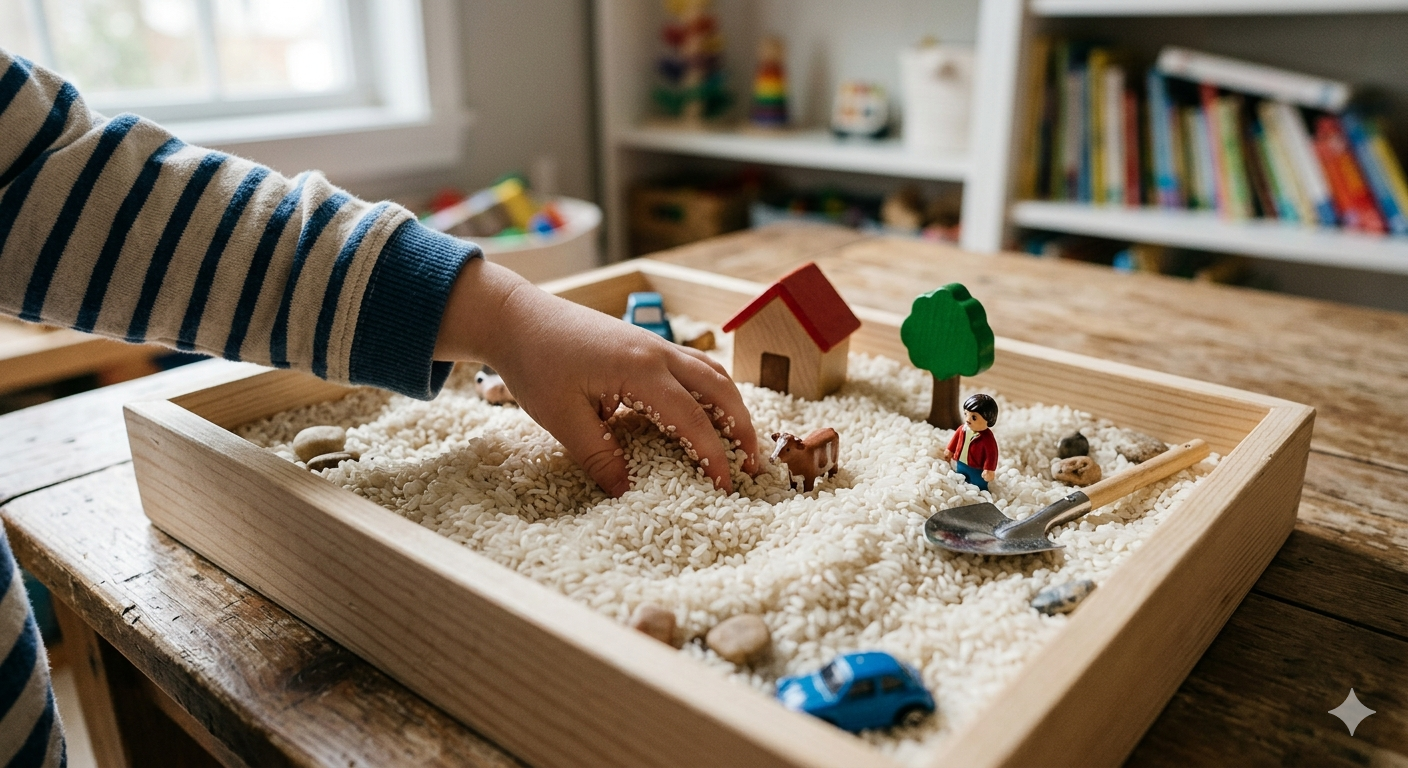
Sandplay was first introduced alongside ongoing emotional work with older pupils, including a Year 4 autistic boy. The following term, the practitioner began offering Sandplay to five children: four in EYFS aged four, and one Year 1 child who was the sibling of one of the EYFS pupils.
The children had experienced significant early adversity. Several were looked-after children in temporary foster care. There were experiences of domestic violence, neglect, caregiver illness, and in some cases, children had been explicitly told not to speak to anyone about what was happening at home. Trust was fragile.
Prior to Sandplay, the school already had strong emotional wellbeing provision, including ELSA, Messy Senses, Lego Therapy, and Drawing and Talking. However, following discussions with the SENCO and Inclusion Champion, Sandplay was introduced to support the complex emotional needs of these very young children.
Why Sandplay for 4–5 Year Olds?
The practitioner felt Sandplay was developmentally appropriate for EYFS because children at this age have vivid imaginations and naturally communicate through play. It offered concentrated, consistent adult attention, something especially important for children whose home lives were unpredictable.
Although initially nervous about working with such young children in this way, she revisited her training materials and accessed supervision when needed. With preparation and support, her confidence grew.
The Sessions
Sessions took place in the morning, ensuring children were not distracted by hunger before lunch. The space was a quieter, slightly separated area within EYFS — private enough for emotional safety, yet visible and appropriate within a school environment.
When children arrived, the Sandplay tray and toys were already set up. The practitioner introduced the sessions in similar language to Drawing and Talking, explaining that they could create anything they wished, that their work would be kept safely in a folder, and that confidentiality would be maintained except in cases of harm.
Initially, the children were guarded. They explored the sand with their hands before gradually introducing toys. Some integrated other elements of the room, such as a nearby play kitchen, into their story world. Attention sometimes wandered — books were picked up, toys explored — but these were gently incorporated into the narrative rather than shut down.
Over time, the practitioner noticed patterns: toys hiding in the sand and storylines involving fixing, healing, or teaching.
Emotional Expression and Impact
Over the weeks, significant changes emerged.
The children’s confidence grew. They would beam when they saw the practitioner, often running to greet her with hugs. They began to share small snippets of their lives outside of sessions, moments of trust that were acknowledged and then gently contained within the therapeutic space.
Emotionally, expression became richer. Children used toys to speak for them, or pretended toys did not want to talk. The treasure chest became a powerful symbol, holding emotions, secrets, and stories. Narratives became more detailed, more confident.
Regulation improved within sessions. While transitions back to class could sometimes be challenging — particularly when children did not want to leave — overall anxiety reduced. Nervousness at the start of the programme disappeared. Children approached sessions with anticipation.
In terms of engagement, children who had initially hid within the room began exploring more confidently. They challenged questions rather than avoiding them. Play matured — cooking dinner, pretending to be teachers, proudly demonstrating what they were learning.
A Significant Moment
One particularly powerful moment occurred with a young girl who had been told not to talk about what was happening at home.
During a session around week four or five, she placed toys repeatedly into a treasure chest — something she had done in previous sessions. When gently asked whether anyone would know where the toys were or miss them, she responded that it was a secret. When asked whether the chest liked keeping secrets, her reaction was immediate and intense. She slammed the chest shut and threw it across the room, stating she did not want to play anymore.
The practitioner calmly reassured her that stopping was fine. They sat together quietly for the remaining ten minutes.
This moment highlighted the depth of emotional processing taking place — and the importance of patience, containment, and sensitive handling.
Belonging and Emotional Safety
Consistency proved vital. The children knew someone would be there for them, reliably, each week. For children whose lives were marked by instability, this routine fostered trust and attachment.
Other children became curious about the sessions, often gathering at the gate wanting to know what was happening. Sandplay became something valued within the setting.
Staff observed increased confidence and emotional development. While transitions back to class occasionally caused disruption, the wider emotional growth was noticeable.
Practitioner Reflection
For the practitioner, Sandplay deepened her understanding of both Drawing and Talking and the power of careful listening. Watching children’s play narratives unfold — rather than relying solely on drawing — offered fresh insight into their emotional worlds.
She reflected that young children experience far more complex emotions than adults sometimes assume. They know when something feels “good” or “bad”. They need safe outlets and adults who do not close down what they are expressing.
If starting again, she would allow even more time for observation before asking questions, trusting the process further.
She believes one of the greatest misunderstandings about emotional support in EYFS is the idea that children are too young to benefit. Her experience suggests the opposite.
Advice to Other EYFS Settings
Her advice to other settings is simple: Do it.
Know the child. Look for changes. Trust the process. Be prepared to be surprised.
She believes Sandplay is particularly suited to 4–5-year-olds because play is their natural language. They respond to attention, care, and consistency. For some, their emotional needs may not be met anywhere else.
However, she is clear that appropriate training is essential. As someone new to working with children, she found Advanced-level training invaluable, and emphasises the importance of supervision and ongoing professional support when working at this depth.





.png)